

The interstellar comet C/2025 N1 (3I/ATLAS), discovered on July 1, 2025, is an exceptionally rare object that arrived from beyond our solar system. To date, only two interstellar objects have ever been confirmed—C/2017 U1 (1I/ʻOumuamua) and C/2019 V4 (2I/Borisov). Researchers have observed these visitors across multiple wavelengths, including optical, infrared, and radio, in an effort to understand the properties of materials formed outside the solar system.
In our solar system, comets are known to emit X-rays. Cometary X-ray emission was first discovered in 1996 from Comet Hyakutake and was later confirmed in several other comets. The situation is different for interstellar comets passing through our solar system. Although attempts have been made to observe X-rays from these objects, none have been successfully detected. Whether interstellar comets behave like ordinary solar system comets—or exhibit entirely different characteristics—has remained a long-standing mystery. Against this backdrop, the highly active comet 3I/ATLAS emerged as an ideal target for X-ray observation.
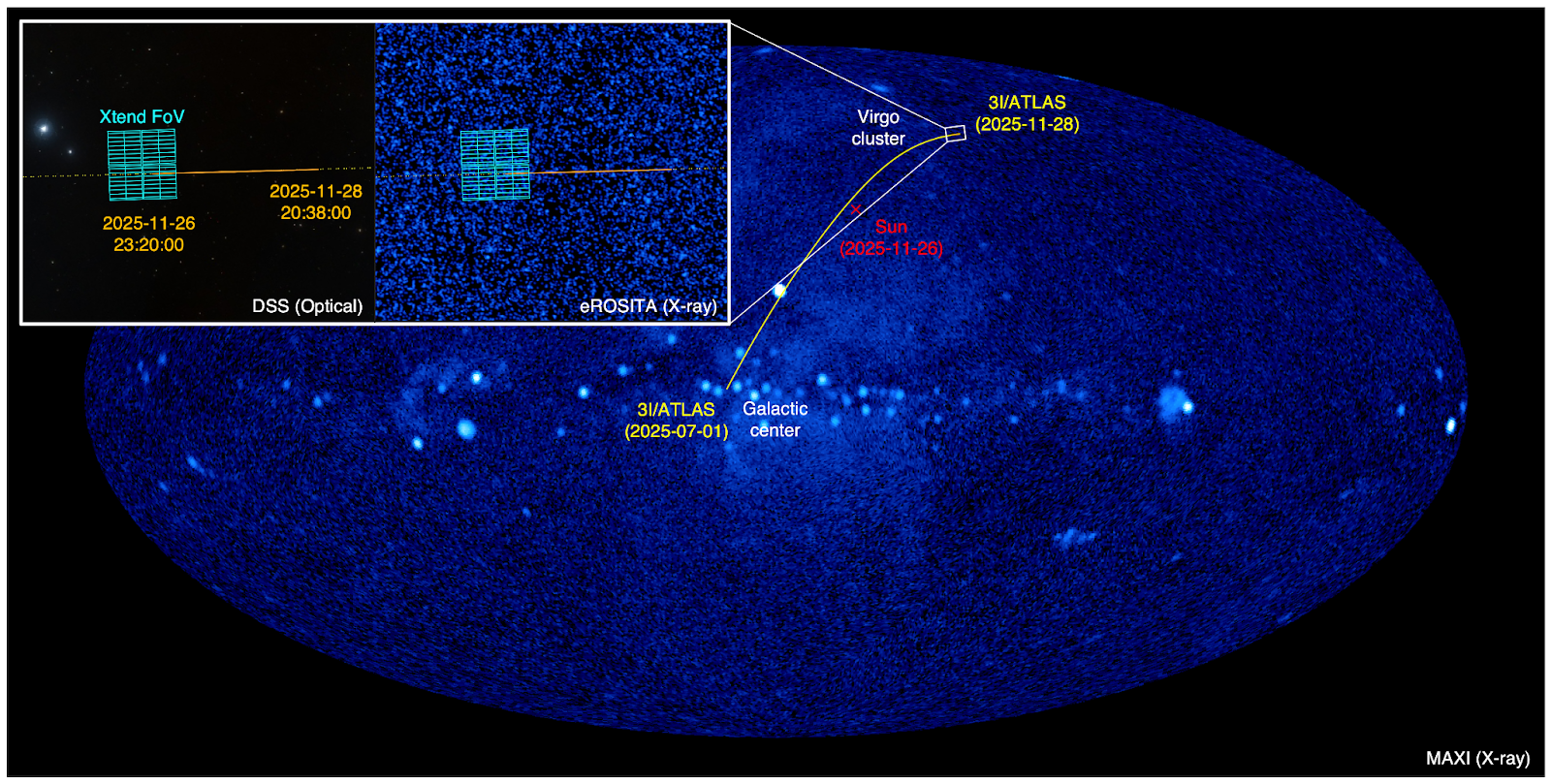
To take advantage of this opportunity, the X-ray astronomy satellite XRISM carried out a Target of Opportunity observation of 3I/ATLAS. A comet appears brightest near perihelion, its closest point to the Sun. XRISM’s instruments cannot point close to the Sun and must maintain a separation of at least 60 degrees from it. The observation was therefore carefully scheduled to coincide with the moment when the comet had moved far enough from the Sun to fall within XRISM’s allowable pointing window. From 23:20 on November 26 to 20:38 on November 28, 2025, XRISM conducted observations with an effective exposure of 17 hours. As shown in Figure 1, the comet drifted slowly across the constellation Virgo during the observation, so the satellite’s attitude was adjusted approximately once every three hours—14 times in total—to keep the comet near the center of the field of view of the soft X-ray imaging telescope Xtend1.

A preliminary analysis of the obtained data, after reconstructing images centered on the comet, revealed a faint X-ray glow extending roughly 5 arcminutes—corresponding to a distance of 400,000 km—around the cometary nucleus, as shown in Figure 2. This extent is difficult to explain solely by the blur due to XRISM’s imaging performance, suggesting the possibility of a diffuse cloud of gas surrounding the comet and faintly glowing in X-rays over several hundred thousand kilometers. However, similar structures can arise from instrumental effects such as vignetting2 or detector noise, so more careful analysis is required before confirming the emission as truly cometary in origin.

Comets are enveloped by clouds of gas produced as sunlight heats and vaporizes their icy surfaces. When this gas interacts with the energetic stream of charged particles flowing from the Sun—the solar wind—a process called charge-exchange3 reaction occurs, producing characteristic X-ray emission. Figure 3 shows the Xtend spectrum extracted from the region near the comet’s center. X-ray components likely associated with carbon, nitrogen, and oxygen appear in ways that cannot be explained by ordinary background emission, such as Galactic X-rays or Earth’s atmospheric emission. This provides an important clue that the observed emission may indeed arise from charge-exchange interactions between the cometary gas and the solar wind.
XRISM’s findings were released on December 3 as a rapid announcement in The Astronomer’s Telegram (ATel)4. Other teams have already begun planning follow-up observations, and the early data obtained by XRISM have become a key foundation guiding subsequent observational campaigns. Moving forward, the XRISM team will continue refining its data processing and analysis to further reveal the activity of this interstellar comet and the nature of its interaction with the solar wind.
1Xtend
Xtend is the soft X-ray imaging telescope onboard XRISM. It consists of an X-ray telescope that focuses incoming X-rays and an X-ray CCD camera that detects them. With a wide field of view—approximately 38.5 × 38.5 arcminutes2—Xtend can capture extended celestial objects such as supernova remnants in a single exposure while simultaneously measuring X-ray energies to obtain spectral information. The instrument was developed mainly by ISAS/JAXA together with universities and research institutes in Japan. Xtend forms one of the two primary instruments on XRISM, paired with Resolve, which performs high-resolution X-ray spectroscopy.
2Vignetting
Vignetting refers to the decrease in detected X-ray intensity toward the edges of the field of view, even when observing a uniformly bright source. Because the central region appears relatively brighter, this instrumental effect can sometimes mimic the appearance of an extended structure.
3Charge-exchange reaction
A charge-exchange reaction occurs when a positively charged ion (an atom that has lost one or more electrons) collides with a neutral atom or molecule and captures one of its electrons. Immediately after the capture, the ion is in a highly excited state. As it transitions down to a more stable, lower-energy state, it emits characteristic X-ray photons.
4The Astronomer’s Telegram (ATel)
An online platform for rapidly disseminating urgent astronomical discoveries and alerts among astronomers.