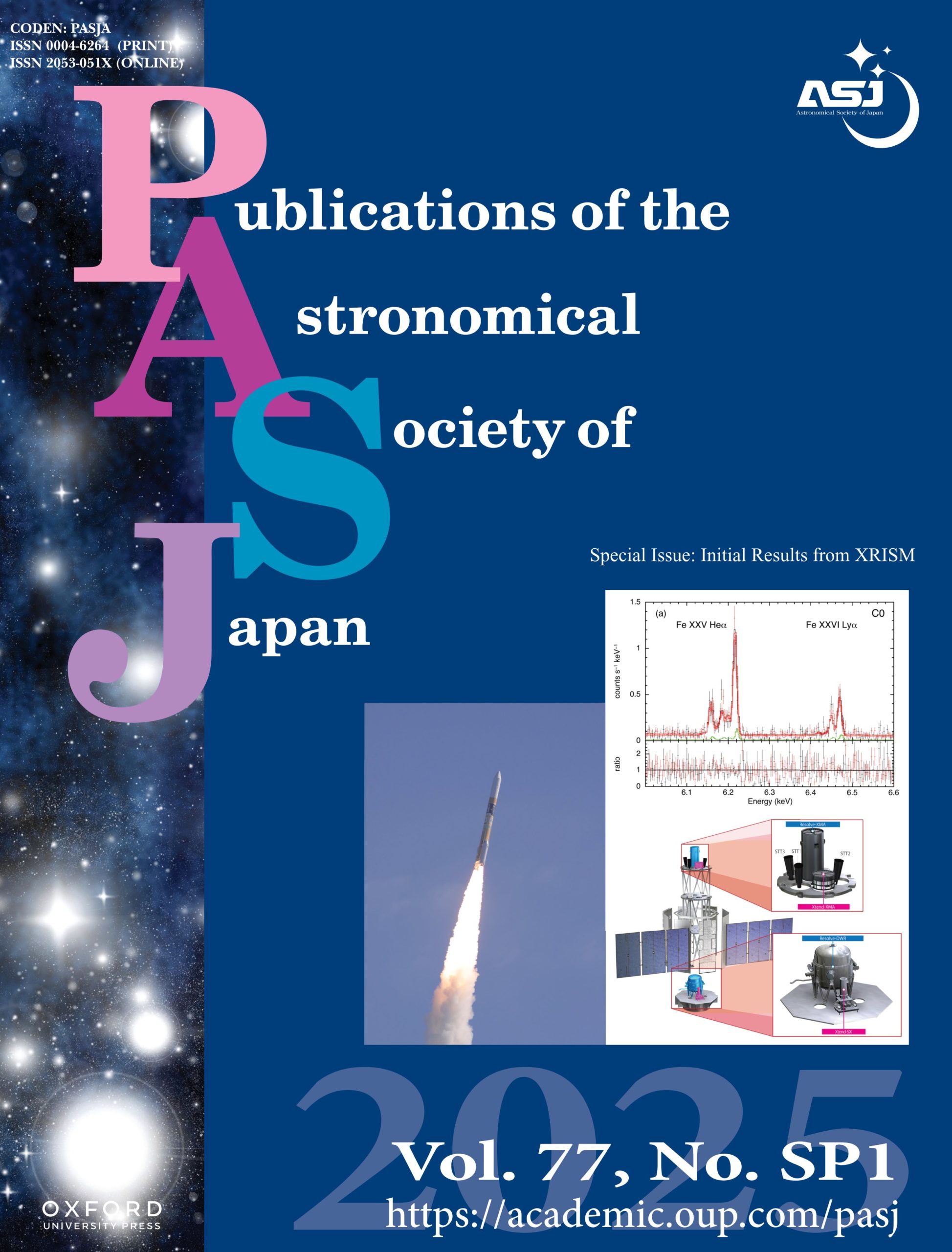
The PASJ ( Publications of the Astronomical Society of Japan) special issue on XRISM has been published.


The PASJ ( Publications of the Astronomical Society of Japan) special issue on XRISM has been published.

Black Hole “Blast” Reaches 300,000 Light Years
A team of researchers has discovered that the winds generated by supermassive black holes are 100 times more powerful than previously thought, carrying energy across distances of approximately 300,000 light-years. The discovery demonstrates that these explosive winds impact the vast expanse of space beyond the galaxies they inhabit.

XRISM Performs a “CT Scan” of Gas Flowing into a Neutron Star
Astronomers have finally pulled off an X-ray “CT scan” of a neutron star system, turning a long-standing dream into reality. Using XRISM’s ultra-precise Resolve spectrometer, they can now track tiny Doppler shifts in iron X-ray emission lines over a full orbit and reconstruct how hot gas is flowing in three dimensions. Applying X-ray Doppler tomography to the binary 4U 1822–371, the team discovered that the iron X-rays don’t come from a neat disk or the neutron star’s surface, but from a turbulent impact zone where the gas stream from the companion star slams into the accretion disk and splashes above it. This is the first time the flow of gas around a compact object has been “imaged” in X-rays and the exact origin of iron fluorescence pinned down. With XRISM, astronomers can now probe extreme gravity and violent accretion physics in unprecedented detail—and this is just the beginning.

A fast starburst wind consumes most of the energy from supernovae
In starburst galaxies, numerous supernova explosions associated with intense star formation heat the gas in the central regions to temperatures high enough to emit X-rays. This hot gas acts as the driving source, pushing and entraining surrounding material to produce a fast outflow (a galactic wind*4; see Fig. 1). This flow can include components that remain within the galaxy, as well as components that escape into intergalactic space. Such flows transport matter and energy―including heavy elements produced inside stars―between the interior and exterior of galaxies and play an important role in galaxy evolution and the matter cycle in the Universe. However, previous observations have mainly traced the motion of entrained material, and direct measurements of the motion of the driving hot gas have been difficult. Consequently, it has remained a long-standing challenge to observationally determine how much supernova energy is stored in hot gas and how much material is driven out of galaxies.