

Astronomers have finally pulled off an X-ray “CT scan” of a neutron star system, turning a long-standing dream into reality. Using XRISM’s ultra-precise Resolve spectrometer, they can now track tiny Doppler shifts in iron X-ray emission lines over a full orbit and reconstruct how hot gas is flowing in three dimensions. Applying X-ray Doppler tomography to the binary 4U 1822–371, the team discovered that the iron X-rays don’t come from a neat disk or the neutron star’s surface, but from a turbulent impact zone where the gas stream from the companion star slams into the accretion disk and splashes above it. This is the first time the flow of gas around a compact object has been “imaged” in X-rays and the exact origin of iron fluorescence pinned down. With XRISM, astronomers can now probe extreme gravity and violent accretion physics in unprecedented detail—and this is just the beginning.
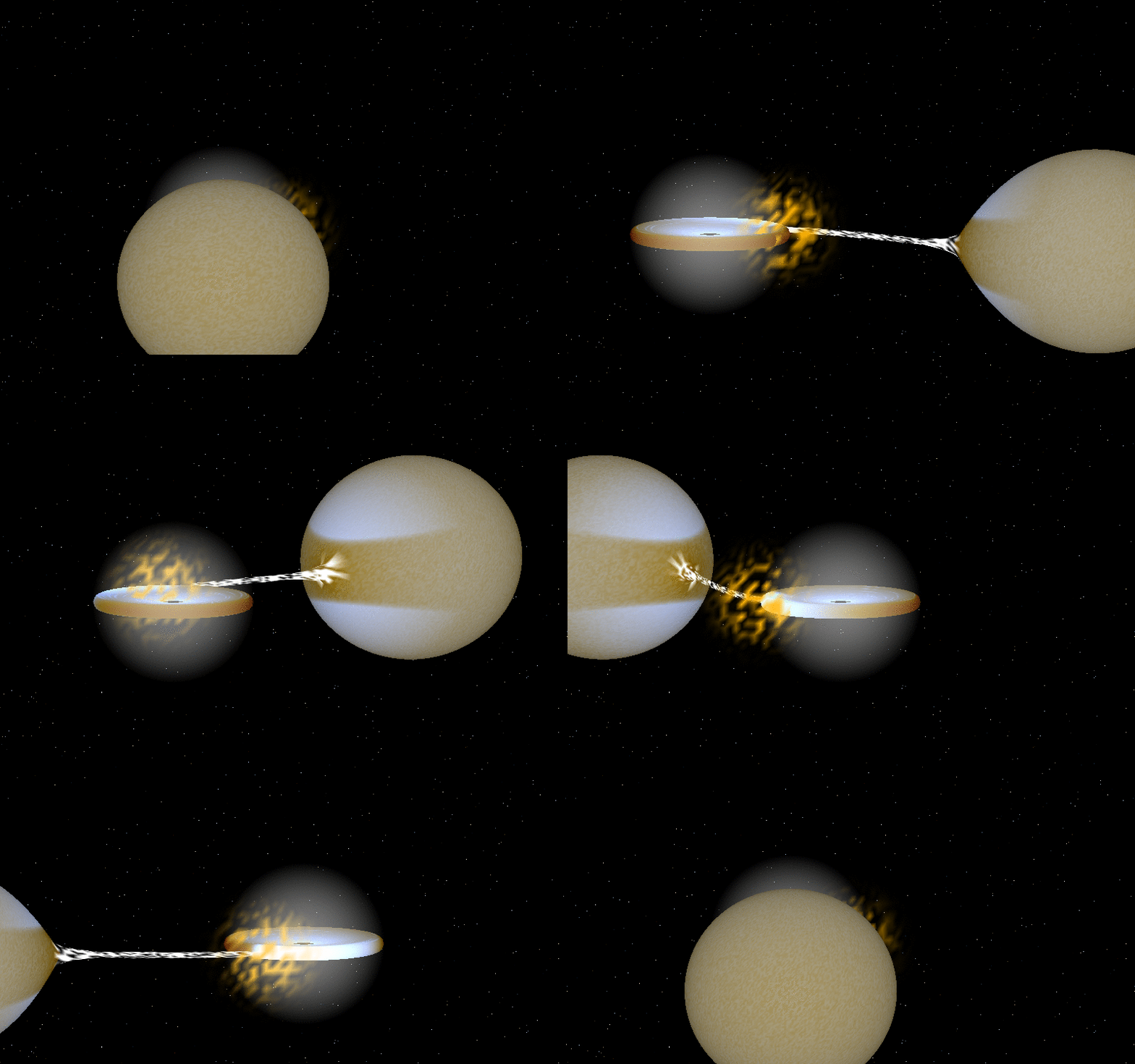
A New Way to “See” Invisible Flows Around Compact Objects
The universe is filled with compact objects – black holes and neutron stars – where enormous mass is squeezed into a tiny volume. These exotic bodies often live in binary systems, orbiting a companion star and pulling its gas into a spiraling accretion disk that shines brilliantly in X-rays. Yet the turbulent flows of gas occur on scales far too small and distant to be captured in a conventional image, so their structure and motion must be decoded from the X-rays they emit.
From Spectra to “CT Images”: Doppler Tomography
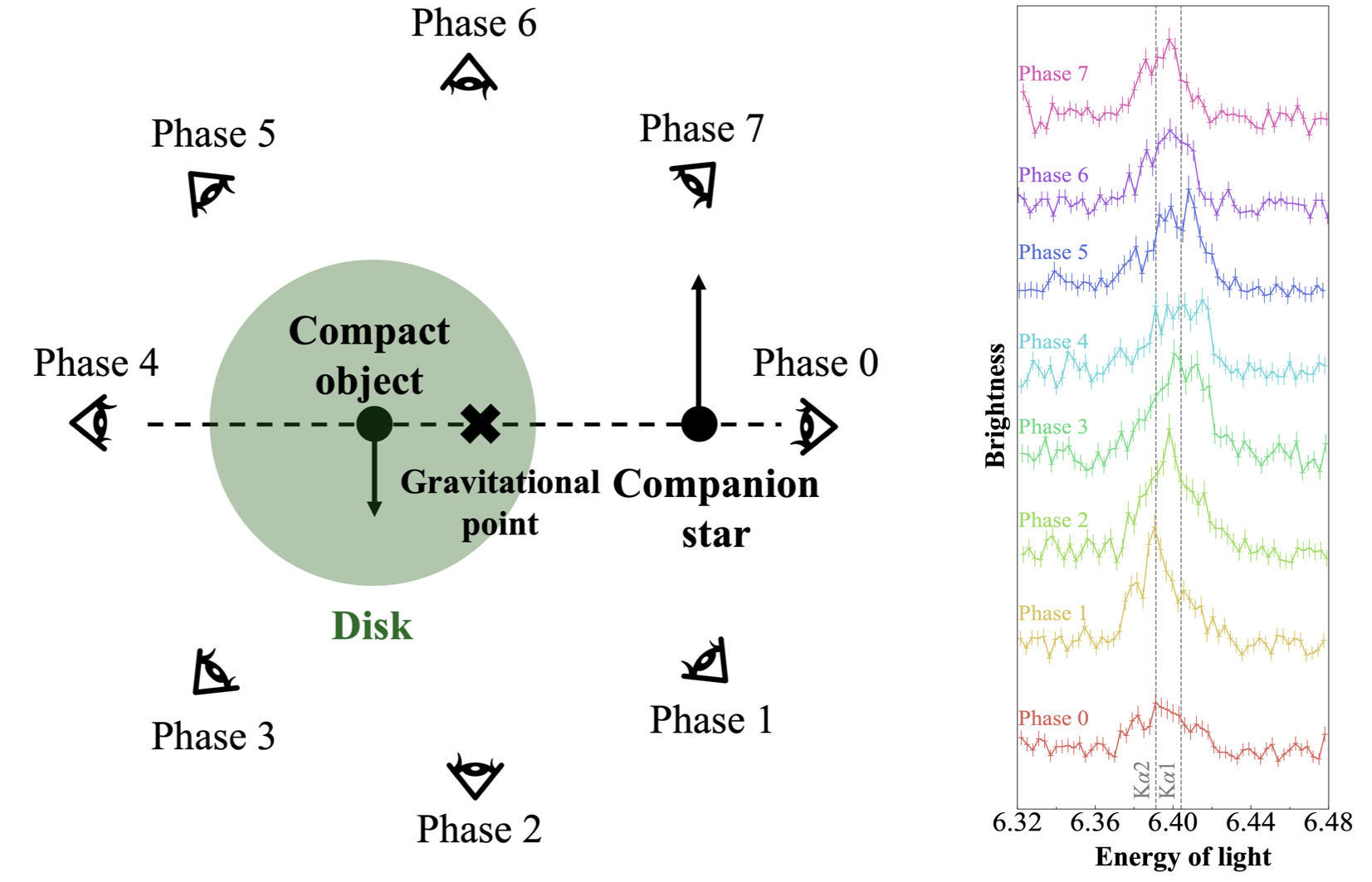
As gas orbits in a binary system, its light is subtly shifted in energy by the Doppler effect: emission from gas moving toward us is shifted to higher energies, while gas moving away is shifted lower. By tracking how these shifts change over a full orbit, astronomers can reconstruct where the emission is strongest in “velocity space” – essentially mapping which way the gas is moving and how fast (Figure 2). This technique, known as Doppler tomography, is conceptually similar to a medical CT scan, which combines many views from different angles to build up a cross-sectional image of the body. Although Doppler tomography has been highly successful at visible wavelengths, X-ray applications have been out of reach because they demand exquisitely fine spectral resolution and high sensitivity.
Resolve: XRISM’s Spectral “Zoom Lens”
XRISM’s Resolve instrument finally makes this ambitious goal achievable. Resolve is a high-resolution X-ray spectrometer that acts like a powerful zoom lens in energy space, able to distinguish tiny differences in X-ray photon energies. It can detect Doppler shifts corresponding to velocities of just a few parts in 100,000 of the speed of light, turning previously blurred X-ray line profiles into sharp, structured features that trace orbital motions. At the same time, Resolve collects enough X-ray photons to follow how these spectral features evolve over time, enabling true X-ray Doppler tomography for the first time (Figure 3).
Imaging the Flow Around a Neutron Star with X-ray Doppler Tomography
Using XRISM, researchers targeted the neutron star binary 4U 1822–371 in the constellation Corona Australis, where a compact neutron star is actively accreting gas from a companion. Resolve revealed that the central energies of iron fluorescence lines from this system vary periodically in lockstep with its orbital motion. These regular shifts provide exactly the information needed to reconstruct a Doppler tomogram – a map of the gas in velocity space. The resulting map shows that the iron fluorescence does not arise from a simple, symmetric disk or directly from the neutron star’s surface. Instead, it originates in a region high above the disk, where the incoming gas stream from the companion plunges into the accretion disk and splashes out, creating a bright, turbulent impact zone.
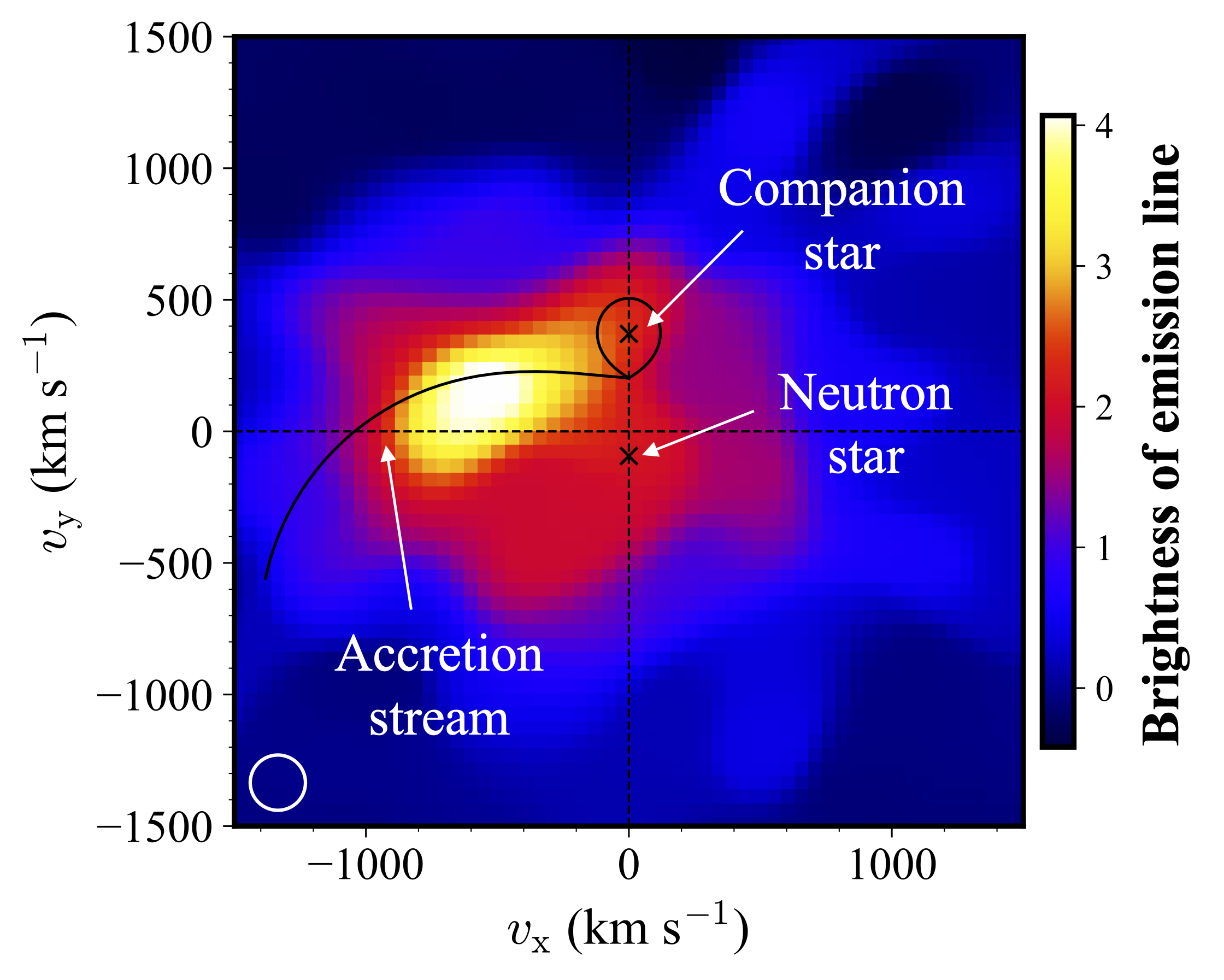
This is the first time that the gas flow around a compact object has been effectively “imaged” in X-rays, and the first direct identification of the region producing iron fluorescence in such a system. While optical Doppler tomography traces cooler gas farther from the compact object, X-ray Doppler tomography with Resolve probes much hotter material that glows as it absorbs intense X-rays close to the neutron star. By revealing this previously hidden structure, XRISM opens a new window on how matter behaves under extreme gravity and radiation.
A New Tool for Mapping Extreme Environments
The success of this study shows that XRISM’s Resolve instrument has inaugurated a new era in high-resolution X-ray spectroscopy. X-ray Doppler tomography now offers a powerful tool to map the three-dimensional flow of hot gas around compact objects, pinpointing where specific X-ray lines originate and how fast the emitting material is moving. This capability will allow astronomers to test theories of accretion disks, impact regions, and outflows with unprecedented precision. Future XRISM observations will apply this technique to other neutron star systems and black hole binaries, gradually building a richer, more dynamic picture of how the universe’s densest objects draw in, heat, and transform the matter around them. With XRISM and Resolve, the long-imagined “CT scan” of hot, invisible cosmic flows is now a reality, promising many exciting discoveries to come.
Glossary
- Emission Line
Bright radiation emitted at specific wavelengths by atoms or ions. Emission lines provide crucial clues about the physical conditions—such as temperature, density, and motion—of the gas around celestial objects. - Iron Fluorescence Emission Line
An X-ray emission line produced when an inner electron in an iron atom is ejected by X-rays or other energetic radiation, and an outer electron drops down to fill the vacancy. Iron fluorescence lines are powerful probes of the gas surrounding neutron stars and black holes. - Doppler Shift
A change in the observed wavelength (or energy) of light when the source is moving toward or away from the observer. The same principle explains why an ambulance siren sounds higher-pitched as it approaches and lower-pitched as it moves away.
Paper Information
Title: X-ray Doppler tomography of Fe Kα emission in a low-mass X-ray binary 4U 1822−371―A localized reflector at the accretion stream-disk overflow
Journal: Publications of the Astronomical Society of Japan, psag033,
DOI: 10.1093/pasj/psag033


