

Nearly every galaxy in the Universe harbors a supermassive black hole at its center, with masses ranging from millions to billions of times that of the Sun. It is believed that these galaxies and black holes have grown together through a process of co-evolution, influencing the development of each other. A key to understanding this relationship is the “ultra-fast outflow,” which refers to the powerful winds blowing from the vicinity of the black hole. However, it has remained a major mystery when these winds develop and at what point they begin to impact the evolution of the galaxy.
A research team, including Associate Professor NODA Hirofumi and Assistant Professor YAMADA Satoshi of Tohoku University, and Project Researcher OGAWA Shoji of JAXA/ISAS, observed the object IRAS 05189-2524 using the X-ray Imaging and Spectroscopy Mission (XRISM). This object is a merging galaxy characterized by a starburst, where a supermassive black hole has begun to activate. By utilizing the state-of-the-art X-ray spectroscopic instruments onboard XRISM, the team detected multiple bullet-like ultra-fast outflows ejected from the vicinity of the black hole at velocities of approximately 7.5%, 10%, and 14% of the speed of light (Figure 1). The study revealed that the energy carried by these winds is more than 100 times greater than that of the slower molecular winds spreading throughout the galaxy, demonstrating that they are powerful enough to dictate galactic evolution. This achievement provides crucial evidence by capturing the exact stage where winds from a supermassive black hole begin to influence their host galaxy, representing a significant step forward in understanding the co-evolution of galaxies and black holes.

Research Summary
Background
The Universe is home to countless galaxies, each comprising hundreds of billions of stars. Modern astronomy has revealed that nearly every galaxy harbors a supermassive black hole at its center and it is believed that galaxies and their central black holes have evolved under the influence of one another. This relationship of “co-evolution” has become one of the most vital research themes in the field today. The key to understanding this co-evolution lies in Active Galactic Nuclei (AGN), which emerge when a black hole consumes vast amounts of surrounding matter. Among these, the most vigorously active are known as “quasars.” These objects are famous for emitting intense radiation that can surpass the collective luminosity of an entire galaxy. Furthermore, observations of some quasars have identified “ultra-fast outflows” (UFOs), which are powerful winds blowing from the vicinity of the black hole at velocities reaching tens of percent of the speed of light. It has been suggested that these winds may profoundly impact galactic evolution by heating or blowing away gas within the galaxy, thereby suppressing the formation of new stars. However, it remains a major question exactly when these winds begin to develop in the growth process of a supermassive black hole, and at what point they start to exert a decisive influence on the evolution of their host galaxy.
Results
A research team, including Associate Professor NODA Hirofumi (Graduate School of Science, Tohoku University), Assistant Professor YAMADA Satoshi (Frontier Research Institute for Interdisciplinary Sciences, Tohoku University), and Project Researcher OGAWA Shoji (JAXA/ISAS), selected the celestial object IRAS 05189-2524 as their observation target for the X-ray Imaging and Spectroscopy Mission (XRISM). This object is believed to be in a stage where a supermassive black hole has just begun to activate at the center of a merging galaxy experiencing explosive star formation. The team conducted observations in August 2024 using XRISM.
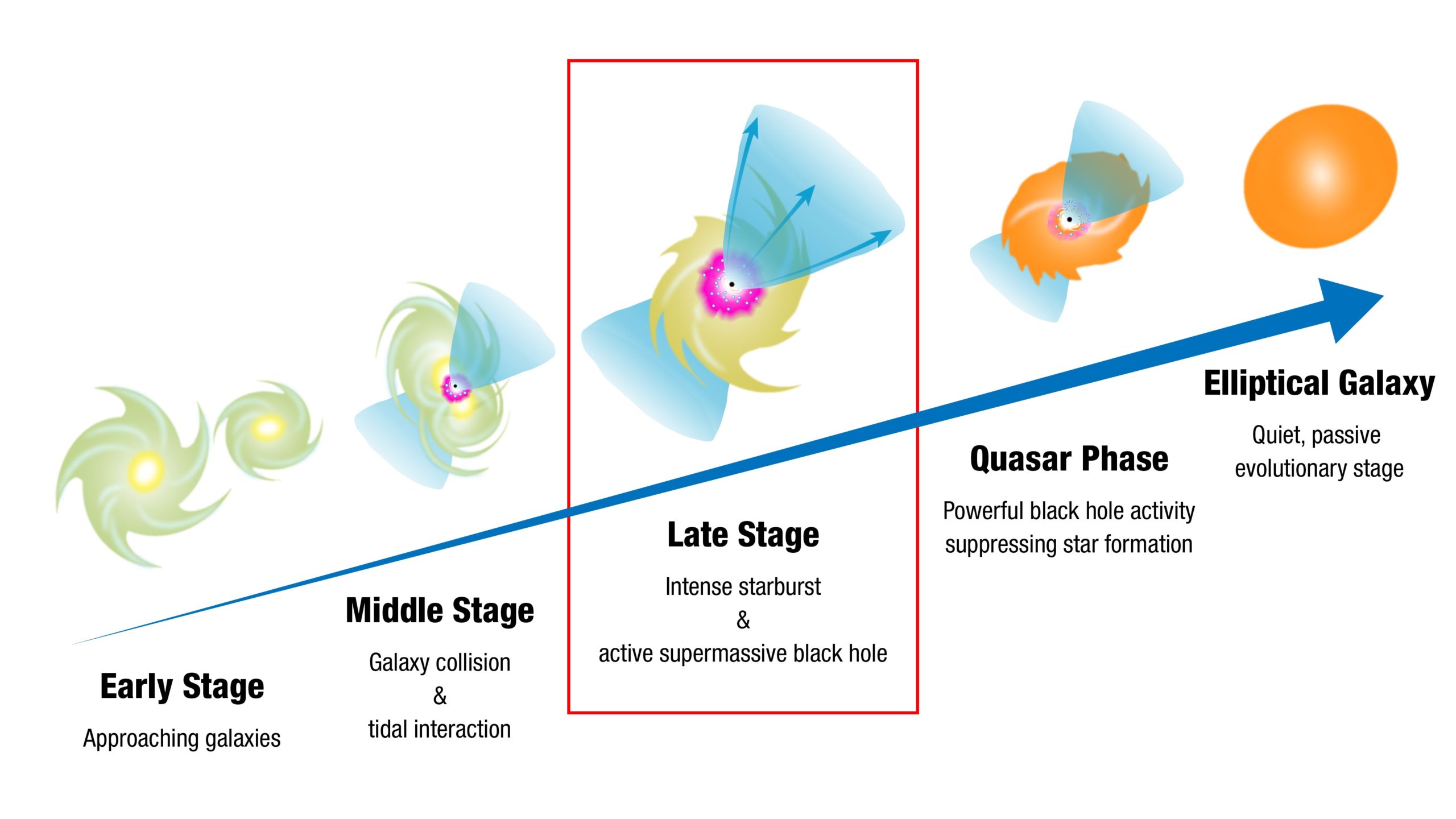
As illustrated in Figure 2, many large galaxies are thought to have undergone mergers in the past, and such processes are believed to trigger explosive star formation (starbursts). These merging galaxies contain vast amounts of matter, which flows toward the central supermassive black hole and gives rise to an Active Galactic Nucleus (AGN). The resulting energy emission and other factors gradually suppress star formation, eventually leading to the emergence of a quasar. Ultimately, the activity of the black hole ceases, and the system settles into a quiet, mature phase as an elliptical galaxy. In this evolutionary sequence of galaxies and supermassive black holes, IRAS 05189-2524 represents a critically important stage where late-stage merging, explosive starburst activity, and an active galactic nucleus coexist.
The observations conducted with the Soft X-ray Spectrometer, Resolve, onboard XRISM, revealed an unprecedentedly complex X-ray spectral structure in the 7–9 kiloelectronvolt (keV) energy range (Figure 3). This structure is interpreted as the result of X-rays generated near the supermassive black hole interacting with highly-ionized iron ions within the ultra-fast outflows, appearing as a series of absorption and emission lines*1. Detailed spectroscopic analysis has clarified that bullet-like ultra-fast outflows are being ejected in all directions from the vicinity of the black hole. Among these, at least three distinct components were found to be moving toward the observer at velocities of approximately 7.5%, 10%, and 14% of the speed of light (Figure 1).
The high energy resolution of Resolve allowed the team to capture the motions and spatial distributions of these “bullets” in detail, enabling a highly accurate estimation of the energy carried by each component. The results show that the total energy of these ultra-fast outflows is more than 100 times greater than that of the slower molecular winds observed on a galactic scale. This energy is considered sufficient to suppress the explosive star formation currently occurring within the merging galaxy, indicating that ultra-fast outflows can strongly influence galactic evolution.
Furthermore, wide-band X-ray observations using the Soft X-ray Imager onboard XRISM, Xtend (Figure 3), revealed that the supermassive black hole in IRAS 05189-2524 is consuming vast amounts of matter at a rate near its theoretical limit. This extremely violent accretion of matter onto the black hole is likely driving the generation of these powerful, bullet-like ultra-fast outflows.

Conclusion and Future Outlook
This study represents a groundbreaking achievement by directly capturing powerful ultra-fast outflows emanating from the vicinity of a supermassive black hole during the late stage of a galactic merger, a period characterized by explosive star formation that eventually evolves into a quasar. It is truly a moment that can be described as a newly awakened monster letting out a ‘roar’ to announce its presence to the entire galaxy. In the case of IRAS 05189-2524, it is anticipated that as the activity of the black hole further intensifies, star formation will be suppressed, leading the system into the quasar phase.
Looking ahead, the scope of research is expected to expand. In addition to XRISM, future missions such as the ESA-led NewAthena, a large-scale international X-ray observatory equipped with an even more advanced X-ray microcalorimeter, are planned. These next-generation tools will allow scientists to investigate various evolutionary stages, ranging from the initial phases of galactic mergers to the peak of quasar activity. By systematically examining these objects, we expect to gain a more comprehensive understanding of the physical mechanisms behind the co-evolution of galaxies and supermassive black holes and the profound impact these black holes exert on galactic evolution.
Terminologies
*1 Ultra-Fast Outflows: In an ultra-fast outflow, iron atoms are highly ionized due to the intense X-rays emanating from the vicinity of the supermassive black hole. When incident X-rays undergo photoelectric absorption within this outflow, absorption structures from helium-like iron ions (6.7 keV) and hydrogen-like iron ions (7.0 keV) appear. Because these structures are shifted to higher energies by the Doppler effect according to the velocity of the wind, it is possible to precisely investigate both the existence and the speed of the outflow.
Paper Information
Title : Discovery of Powerful Multivelocity Ultrafast Outflows in the Starburst Merger Galaxy IRAS 05189–2524 with XRISM
Journal : Astrophysical Journal Letters
Authors : Hirofumi Noda, Satoshi Yamada, Shoji Ogawa, Kouichi Hagino, Ehud Behar, Omer Reich, Anna Ogorzalek, Laura Brenneman, Yuichi Terashima, Misaki Mizumoto, Francesco Tombesi, Pierpaolo Condò, Alfredo Luminari, Atsushi Tanimoto, Megan E. Eckart, Erin Kara, Takashi Okajima, Yoshihiro Ueda, Yuki Aiso, and Makoto Tashiro
DOI : 10.3847/2041-8213/ae14e8


